
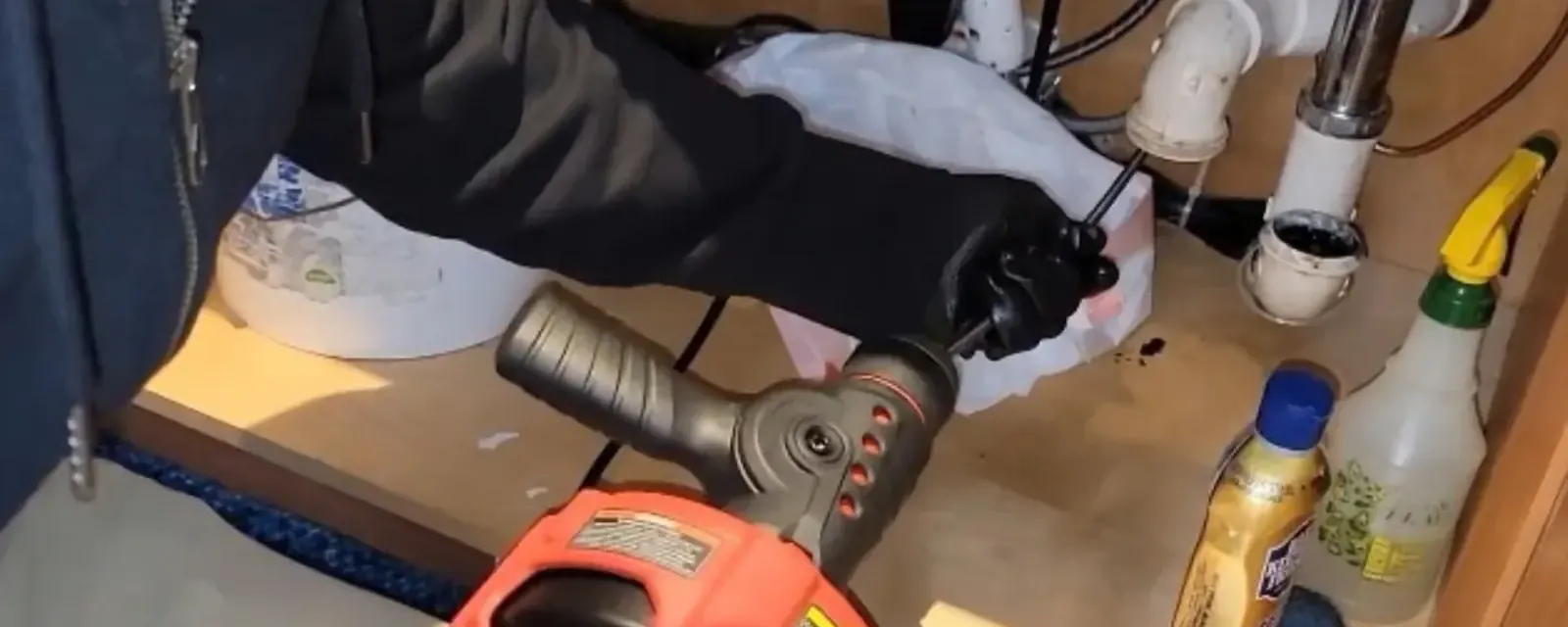
Anatomy of the trap, part by part
Look under the sink and you will see the same handful of pieces in almost every house.
Tailpiece
The straight tube that drops from the sink strainer. It is usually 1 1/2 inch and ends in a slip nut.
Trap bend
The U or J shaped pipe that holds the water seal. The seal depth is normally 2 to 4 inches.
Trap arm
The horizontal run from the bend to the wall. It should tilt slightly downhill, about 1/4 inch per foot.
Slip nuts and washers
Plastic or metal nuts squeeze a tapered washer against each joint. The bevel faces the fitting socket.
Wall stub or trap adapter
The pipe stub coming out of the wall, often 1 1/2 inch, where the trap arm slides in.
Tee or baffle tee
On a double bowl sink, a tee joins the two tailpieces into a single continuous waste.
Why the water seal matters
The trap holds standing water, and that water is the barrier. Sewer gas contains hydrogen sulfide, which smells like rotten eggs, and the seal keeps it out of the cabinet. A seal below 2 inches can siphon out, and one above 4 inches slows the flow.
Every trap needs a vent to work. The vent lets air in behind the water so the drain does not pull the seal down. A gurgle after a big drain, or a bad smell with no leak, points at venting more than at the trap itself.
Sizes and materials at a glance
| Part | Typical size | Common materials | Notes |
|---|---|---|---|
| Kitchen tailpiece and trap | 1 1/2 inch | Plastic, chrome brass | Bath sinks often use 1 1/4 inch instead |
| Trap arm to wall | 1 1/2 inch | Plastic, chrome brass | Must slope toward the wall |
| Wall stub | 1 1/2 or 2 inch | Plastic, galvanized, cast iron | Older homes may have steel that is hard to remove |
| Disposal discharge | 1 1/2 inch | Plastic | Bolts on with a flat gasket |
| Dishwasher branch | Small hose barb | Rubber hose | Joins above the trap, not below |
When replacing a section, match the existing pipe size, because adapter washers can be fiddly and leak.
Odd arrangements you may find
A double bowl sink usually drains through a continuous waste tee that feeds one trap. With a disposal on one bowl, the other bowl's drain often connects to the disposal's inlet or to a tee ahead of the trap.
Older DIY work sometimes includes an S trap, where the pipe turns down into the wall. Current plumbing codes prohibit S traps because they siphon dry. If you find a trap that drops straight into the floor or wall, consider that a re-pipe job.
Garbage disposal and dishwasher connections also change where the trap arm sits. The hose or branch should always connect on the sink side of the trap.
Leak or clog beyond the trap? Call (385) 488-1892 to reach a licensed plumber.
Call (385) 488-1892Fixing a leak at a slip joint
Start with the cheap fixes before you replace anything.
Find the wet joint
Dry every connection with a rag, run water for 30 seconds, and watch where the first bead forms. Press a paper towel to each joint.
Snug by hand first
Turn the slip nut about a quarter turn by hand. Plastic nuts crack when pushed hard with a wrench.
Check the washer
If it still weeps, back the nut off and look at the washer. It must sit with the tapered edge facing into the fitting, and a flattened or cracked washer should be replaced.
Look for cracks
A hairline crack in a plastic bend or a pinhole in a chrome trap will not seal. Replace that piece with a same size trap kit.
Never use pipe dope or silicone on a slip joint. The tapered washer is the seal.
Clearing a clog at the trap
Put a bucket under the trap, unscrew both slip nuts, and lower the bend. Dump the contents, then rinse the bend and check the tailpiece for a plug of congealed grease and coffee grounds. Reassemble with the same washers if they look good.
If the trap is clean and the sink still holds water, the blockage is deeper in the trap arm or the wall branch. A hand auger can reach a few feet. Beyond that, professional drain cleaning with a cable machine saves effort and avoids scraping the pipe.
What Herriman's sewer district and water mean for your trap
Jordan Basin Improvement District serves Herriman and says the homeowner owns the private line from the house to the district main. Its test is simple. If a backup stops when all water use in the house stops, the problem is in the house plumbing or the private lateral. If only the kitchen is slow, start at the trap.
The district also tells residents to keep oil and grease out of every drain and to use strainer baskets. A basket in the sink strainer catches food scraps that otherwise settle in the trap bend.
Herriman's city water is very hard, with local wells at 25 to 60 grains per gallon and Jordan Valley Water supply at 10 to 12. Mineral crust builds on chrome traps and metal slip nuts, which makes them stick. Soak a stuck nut with white vinegar on a rag before you reach for the wrench.
When the problem is not the trap
If tub, toilet, and sink all drain slowly, you are looking at the branch line or the main. If water gurgles in the sink when the washing machine drains, the vent may be the issue. Neither responds to trap work.
Crews dispatched from Herriman also work in Bluffdale and West Jordan, where the same under sink checks apply. Leaks that keep coming back after new washers may involve supply stops and faucet lines above the trap, not the trap itself.
Kitchen sink trap questions
Who is responsible if my kitchen drain backs up in Herriman, the city or the sewer district?
Neither handles the private line. Jordan Basin Improvement District runs the sewer main, and the homeowner owns the line from the house to that main. If the backup stops when all water use stops, it is in the house plumbing or private lateral.
Can I use a flexible trap to fix an odd alignment?
A corrugated flexible trap fits awkward spots, but the ridges catch debris and clog faster than smooth pipe. Use one only when a rigid trap cannot line up.
Why does my trap leak only when the sink is full?
A full sink pushes more water through at once. That usually reveals a joint that is almost tight, a cracked washer, or a hairline crack in the bend.
How often should I clean the trap?
Most households never need to. Clean it when the sink slows, or if you smell grease. A strainer basket and a monthly hot water rinse cut the buildup.
Is a chrome trap better than plastic?
Chrome looks better in an exposed sink, but plastic resists corrosion and is cheaper. In a cabinet, plastic is the practical choice for most homes.
Not sure where the problem sits? Call (385) 488-1892 and describe the leak or the sound.
Call (385) 488-1892Sources and standards
Local rules and figures in this guide come from the public sources below. Fees and codes change, so confirm the current version before you act on it.