
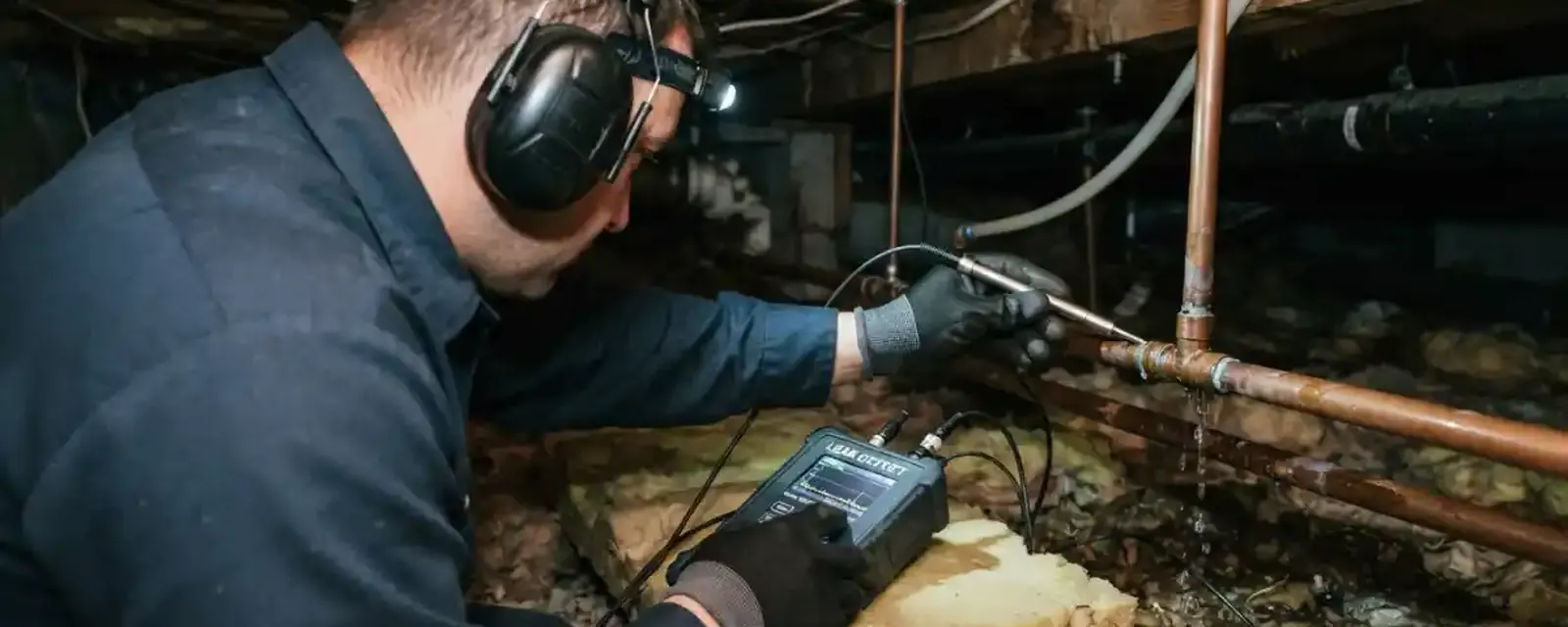
If water is showing up right now
Active water is an emergency, and our 24/7 line is open for it. While you wait for the plumber, shut off the home's main water valve and keep the leak from spreading.
Most main valves sit where the line enters the house, often in a basement, utility room or garage wall. If you cannot find it or it will not turn, say so on the call.
Close the main valve
Turn the handle fully. A ball valve (lever) is closed when the handle sits crosswise to the pipe. A wheel valve closes clockwise.
Keep power away from wet areas
If water is dripping near outlets, light fixtures or a panel, switch off that breaker only if you can reach it without standing in water.
Open one low faucet
Draining the line relieves pressure and slows a leak that is fed from the house side. Close it again once the flow stops.
Protect what you can
Lift rugs and boxes off wet floors, set a bucket under drips, and photograph the damage for your insurer.
Do not drill into a wet ceiling to let it drain unless it is visibly bulging and about to give way. A small relief hole over a bucket is the exception, and you can tell the dispatcher you did it.
Run the meter test before you call
Herriman City publishes a simple leak check, and it is the fastest way to tell whether the leak is inside the house, in the sprinklers or under the yard. It takes about fifteen minutes and needs no tools.
Make the house quiet
Close every faucet. Pause the dishwasher, washing machine, ice maker and any softener that is regenerating. Flush nothing.
Read the dial
Lift the meter box lid and note the reading and the small low-flow indicator. Many meters show a tiny triangle or wheel that spins at even a thread of flow.
Wait and look again
Check after ten to fifteen minutes. If the numbers advanced or the indicator keeps turning, water is leaving somewhere.
Close the house main valve
Shut the home's main valve and the sprinkler main valve, then read the meter again. If it still moves, the leak is on the line between the meter and the house.
Close it off in stages
If the meter stops with the house valve closed, the leak is downstream of it. Close the sprinkler valve alone and test again to separate irrigation from indoor plumbing.
The city also advises hiring a plumber to locate and repair any leaks on your property. Read the dial only. The meter and its setter belong to the city, and Herriman warns that tampering can bring a fine to the homeowner.
A high bill with nothing dripping
The silent leaks behind most high bills are toilets and irrigation. A toilet flapper that no longer seals can pass hundreds of gallons a day without a sound, and a dye tablet in the tank shows it in ten minutes. Leaks at an ice maker line or a water heater fitting run quietly too.
Herriman bills water monthly and one month behind. A leak you fix today may still show on the next statement, so compare meter readings, not invoices, to confirm the repair worked. Take a photo of the dial before and after.
Which tool finds which leak
| Method | What it finds | Works best on | Honest limit |
|---|---|---|---|
| Meter and pressure-decay test | Whether a leak exists and which zone holds it | Every job, as the first step | Does not give a location |
| Acoustic ground microphone and correlator | The hiss or hum of escaping water in pressurized pipe | Buried service lines, slab and wall runs of metal pipe | Plastic pipe and low-pressure leaks make weak sound |
| Thermal imaging camera | Temperature differences from wet material or hot water lines | Hot water leaks, in-wall and ceiling moisture, radiant floors | Shows moisture patterns, not always the exact fitting |
| Tracer gas (hydrogen and nitrogen mix) | Gas rising through soil, concrete or drywall from a pressurized, emptied line | Quiet leaks, plastic pipe, deep or buried lines | Line must be drained and filled, so water is off for a while |
| Moisture meter and borescope | Wet framing, insulation and hidden cavities | Confirming a ceiling or wall suspect through a small hole | Needs one small access hole |
Most finds use two of these. A correlator may put the leak within a few feet, and tracer gas or a camera then confirms it so the dig or the cut is one spot, not a guess.
Wet ceiling, stained wall or soft drywall
The stain tells you part of the story before any gear comes out. A spot that grows only after someone uses the upstairs bath points to a drain or a tub overflow. One that grows around the clock, even overnight, points to a pressurized supply line. A stain that follows rain belongs to the roof, not the plumbing.
The plumber isolates the zone by closing branch shutoffs, runs a thermal camera across the area, and confirms with a moisture meter. Often one small inspection hole behind a cabinet or in a closet ceiling is all that is needed. Drywall patching and paint are outside what the plumber does.
Meter moving, ceiling stained or bill climbing? Call (385) 488-1892 and describe the symptom.
Call (385) 488-1892Under the house, in the crawlspace or basement joists
Crawlspaces and unfinished basements give a plumber direct sight of copper, PEX and drain lines, so many leaks here are found by eye. Look for green crust on copper joints, white mineral trails, a wet vapor barrier, or a joist bay that smells musty.
Where lines are hidden above a finished basement ceiling, the work becomes thermal scanning and listening. Water heater fittings, softener hookups and shutoff valves are the usual suspects, so they are checked before anything is opened.
Buried water lines between the meter and the house
A leaking service line shows up as a meter that runs while the house valve is closed, a soggy patch that stays green in a dry week, or a hiss near the main valve. Pressure at the faucets often sags too. The signs are described in detail on our water line repair page.
To locate it, the plumber walks the likely route with a ground microphone and compares sound at two access points, usually the meter side and the house entry. Digging comes only after the spot is marked. Utah requires a call to Blue Stakes (811) before any excavation, and private lines like yours are not marked by the utilities, so the plumber traces them separately.
Sprinklers, irrigation valves and the secondary water season
A summer bill spike is often irrigation. A cracked zone valve, a broken head or a swing line that fails under pressure can run all night. Closing the sprinkler main valve and re-reading the meter, as in the city procedure, splits the problem in two.
Herriman runs a separate secondary system for untreated irrigation in some areas, available from May 1 to mid October. Secondary is metered, but a leak on that side does not show on your culinary meter. After shutdown, if your culinary meter still moves with the sprinkler valve closed, the leak is not the lawn.
A swing line connects to either culinary or secondary water, so a leak there can drain culinary water you did not expect to spend. Keep your own connections outside the city meter box.
Herriman conditions that affect hidden leaks
Herriman water is very hard by the city's own scale, with local wells running 25 to 60 grains per gallon and the Jordan Valley supply 10 to 12. Scale builds on fixtures and in water heaters, so a white crust on a heater connection often marks a slow weep. Wipe it dry and check it again in a day.
State geologists mapped collapsible soils in the north part of Herriman, soils that settle when they get wet. A buried leak soaks the ground and can undermine its own trench, so do not irrigate over a suspected line and fix it quickly if you live in that area.
The city designs its system for 60 to 120 psi at the tap, and pressure is highest in the lower pressure zones. A cheap gauge on a hose bib shows your number. High pressure strains fittings, toilet fill valves and appliance hoses, so a reading near the top of that range is worth mentioning to the plumber.
What shapes the price of finding and fixing a leak
Detection and repair are priced separately, and the plumber should tell you where the diagnostic ends before the repair begins.
- Where the leak is. A visible crawlspace joint is a short job. A line under a driveway or inside a finished wall needs more equipment and time.
- How many methods are needed. One method is often enough on a metal line. Plastic pipe or a quiet leak may call for tracer gas on top of the listening work.
- Access and restoration. Opening a wall or cutting concrete is extra, and patching drywall, flooring or landscaping is a separate trade.
- The repair itself. A coupling on a copper line costs little. Replacing a long run of buried pipe is a larger project.
- Timing. After-hours dispatch for an active flood is priced differently from a booked visit for a high-bill hunt.
Sudden and accidental water damage is often covered by homeowners insurance, while slow leaks and wear usually are not. Some policies pay for access cost even when they exclude the pipe. Ask your insurer before work starts.
Want your real number? Call (385) 488-1892, describe the symptom and the plumber will tell you what the visit includes before work begins.
Leak detection questions from Herriman homeowners
How do I know if my water meter shows a leak?
Close every tap, then watch the dial or the low-flow indicator for ten to fifteen minutes. Any movement means water is leaving. Close the home's main valve and watch again to learn whether the leak is before or after that valve.
Why is my water bill so high when I see no leak?
Toilets that run silently, irrigation zones stuck on, and slow leaks at the water heater are the top causes. Remember the bill covers last month's use, so a leak found now can still appear on the next statement.
Do you handle leak detection emergencies at night or on weekends in Herriman?
Yes. The line is staffed around the clock for active leaks, and after-hours dispatch is the same call as any other. Availability depends on the evening, so the dispatcher tells you honestly when a plumber can reach you and what to shut off meanwhile.
Can you find a leak without tearing out walls?
Usually. Thermal imaging, acoustic listening and a moisture meter narrow a leak to a small area, and a single inspection hole confirms it. Tracer gas covers quiet or plastic-pipe leaks without opening more than the final repair spot.
How is tracer-gas leak detection done?
The plumber isolates a section of line, drains it and fills it with a harmless mix of hydrogen and nitrogen. A sensor held at the surface picks up gas that escapes through the soil, slab or drywall at the leak.
Do you find sprinkler line leaks?
Yes, including cracked laterals, failed valves and swing-line connections. The plumber tests by zone. Blow-out and winterizing service for sprinklers is normally done by an irrigation company, so we focus on the leak itself.
What about slab leaks?
Most Utah homes sit over basements or crawlspaces, so slab leaks are uncommon here. If you do have a slab-on-grade home or a hot spot on the floor, tell the dispatcher and the same listening and thermal methods apply.
Is leak detection the same as a sewer inspection or burst pipe repair?
No. Leak detection locates slow or hidden water loss in supply and drain lines. A sewer camera inspects the drain lateral, and burst pipe repair fixes a visible failure. One visit can lead to another, and the dispatcher will say which you need.
Ready to book a leak hunt? Call (385) 488-1892 and describe what the meter or the ceiling is doing.
Call (385) 488-1892Sources and standards
The standards and local rules behind this service page are listed below. Rules and fees change, so read the current version before you rely on them.