
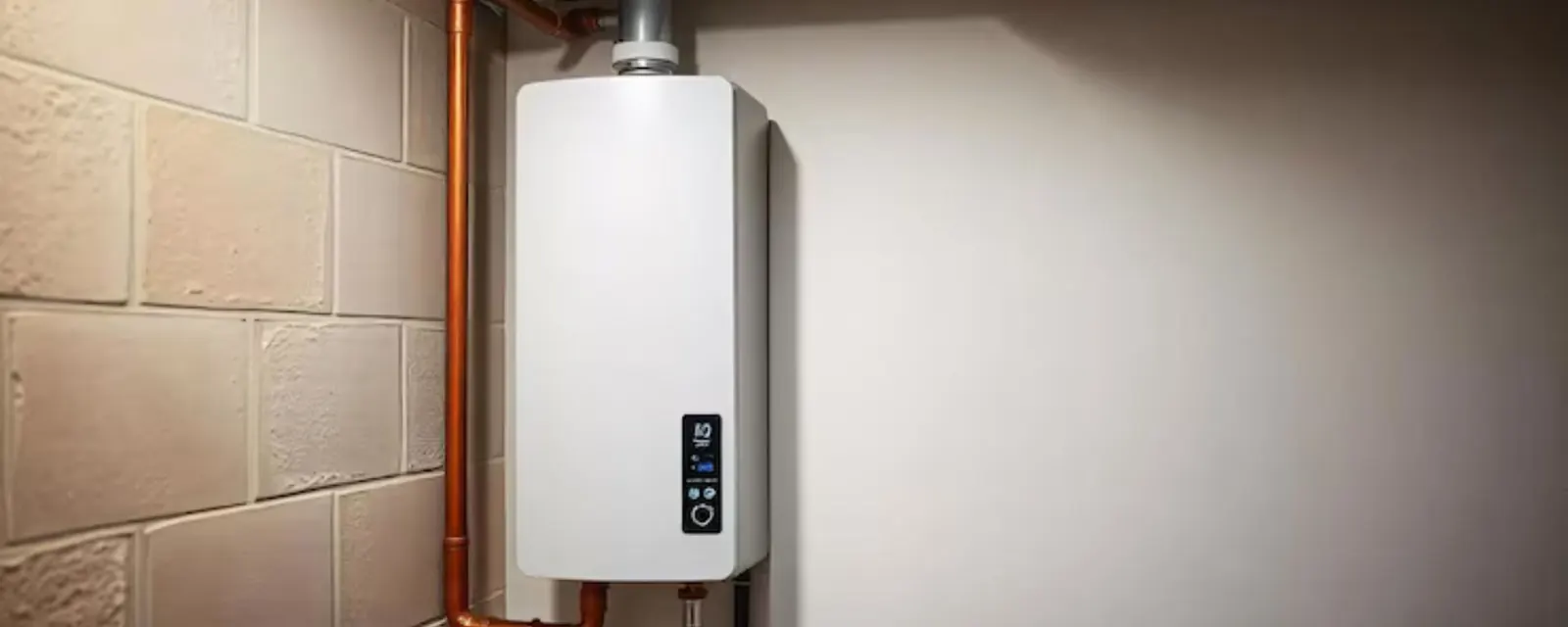
Is tankless right for this house?
A tankless heater heats water only when a tap opens. It has no storage, so it never runs out in a long shower, and it frees up floor space. Savings on the gas bill are real but modest, and they rarely pay back the extra install cost on their own.
It fits best in homes with high, steady demand, limited space, or a tank at the end of its life. It fits poorly where the gas line is undersized, the vent run is long, or the household rarely uses much hot water.
Tank, tankless and hybrid side by side
| Factor | Gas tank | Gas tankless | Electric tankless | Heat pump hybrid |
|---|---|---|---|---|
| Hot water supply | Limited by tank size | Continuous, limited by flow rate | Continuous, limited by amperage | Limited by tank size |
| Install complexity | Low | High, larger gas line and vent | Very high, heavy electrical load | Moderate, needs air space and drain |
| Maintenance | Flush yearly, anode rod | Flush yearly in hard water | Flush, check elements | Flush, clean air filter |
| Space | Floor space | Wall-mounted, small | Wall-mounted, small | Large, tall |
| Main weakness | Runs out, scale on floor | Scale on heat exchanger, minimum flow | Often needs a large panel upgrade | Cools the room, fan noise |
Whole-home electric tankless units draw a very large current, and many existing panels cannot supply it. That is the most common reason we steer people away from them.
The gas line and the city's gas diagram
A tankless gas unit burns far more gas per minute than a tank, even though it only fires on demand. The gas line feeding it has to be sized for that peak load, including every other appliance on the same line. A line that served a tank may be too small.
Herriman's building page says a gas diagram is required for tankless water heaters and other newly added gas appliances. The diagram shows pipe sizes and lengths from the meter to each appliance. We prepare it with the permit, and the inspector checks the finished run against it.
Venting, condensate and clearances
Condensing tankless units pull so much heat from exhaust that they produce acidic condensate. The unit needs a drain for it, often with a small neutralizer cartridge, and a vent in the pipe material the maker specifies, usually PVC, CPVC or stainless. Reusing an old metal flue is a common mistake.
Clearances matter too. The vent terminal needs distance from windows, doors and the gas meter, and the unit needs service room. In a townhome, the vent path may cross shared walls, so confirm with your HOA or property manager first.
Tankless flush and descale, step by step
This is the maintenance most owners skip, and it is the one that matters most in very hard water.
Power down and close valves
Turn off the unit and gas, then close the cold and hot isolation valves. Units without service valves need them installed first.
Connect the pump and hoses
Attach hoses from a small submersible pump to the service ports. The other hose returns to a bucket holding the descaling solution.
Circulate the solution
Run white vinegar or a manufacturer-approved descaler through the heat exchanger for about 45 minutes to an hour. Scale loosens and the color of the solution changes.
Flush with clean water
Disconnect the pump, open the cold supply and run fresh water through the unit until it runs clear.
Clean the inlet filter
Remove and rinse the small screen where cold water enters. Debris there reduces flow.
Restore and test
Open the valves, relight the unit, bleed air from a hot tap and check for leaks at each fitting.
Drain the used solution to a sink or floor drain connected to the sewer, never to the storm drain. Do not mix vinegar with bleach or other cleaners.
Thinking about tankless, or fighting scale on yours? Call and we will talk through it.
Call (385) 488-1892Why very hard water changes the flush schedule
The city reports its wells between 25 and 60 grains per gallon and supplier water around 10 to 12. It calls anything over 10 very hard. A tankless heat exchanger has narrow channels, so scale clogs them far faster than it coats a tank bottom.
Scale shows up as lower flow, rising outlet temperature swings, error codes and a louder burner. Many manuals suggest a yearly flush in hard water. Given what Herriman reports, treat yearly as a minimum, and ask us about checking pressure drop across the unit.
A water softener ahead of the heater cuts scale at the source. Test your tap first, because hardness changes with the water source.
Symptoms and what they usually mean
Not every tankless complaint needs a flush. Match what you see to the likely cause.
- Cold water between hot bursts, called the cold water sandwich. The unit has a minimum flow to fire, and a quick on-off tap leaves a cold slug in the pipe.
- Hot water fades during a long shower. Flow demand exceeds the unit's rating, or scale is limiting heat transfer.
- Error code for ignition, flame or exhaust. Check the vent, gas supply and condensate drain before resetting repeatedly.
- Lukewarm at distant fixtures. Long pipe runs lose heat, and a recirculation pump or a point-of-use heater may be needed.
- Rumbling, kettle-like noise. Scale on the heat exchanger. Flush it.
- No hot water after a power outage. Gas units still need electricity for the fan and controls.
A pressure gauge on a hose bib and a flow measurement at the unit tell us a great deal before we touch a tool.
Minimum flow and the cold water sandwich
Most tankless units need around half a gallon per minute before the burner fires. A low-flow faucet or a trickle from a nearly closed tap may not trigger it. That is by design, not a defect.
Fixes include a small recirculation loop, a buffer tank, or changing habits. If your household takes short bursts of hot water at the sink, a hybrid tank may serve you better. We would rather say so than sell a mismatch.
What we will not do
We do not recommend tankless to a household that rarely draws much hot water and wants to save money, since the install premium may never pay back. We also do not install a tankless unit on an undersized gas line or a vent path the maker does not allow.
Whole-home electric tankless units need a large electrical service. If your panel cannot support one, we will say so rather than force it. Large panel upgrades are electrician work.
What drives tankless pricing
The unit is only part of the cost. The rest is gas, vent and water quality.
- Unit capacity. A single-bath home and a six-fixture home need different flow ratings and different price bands.
- Gas line upgrade. Re-piping the gas line to a larger size adds materials and labor.
- Venting and condensate. New vent pipe, a wall penetration and a neutralizer add to the job.
- Service valves and water treatment. Isolation valves for flushing are low cost to add at install and costly to retrofit later.
- Permit and gas diagram. The permit and the diagram are included in the plan, and you see them as line items.
If a tankless unit fails from scale or wear, the repair is typically your cost and not an insurance matter. Sudden water damage from a burst connection may be covered, so ask your insurer. Check your equipment warranty, since many require documented annual flushes.
Want a real quote? Call (385) 488-1892 and tell us the current heater, the fixtures and where the unit would go.
Tankless questions, answered plainly
Does a tankless water heater need a permit in Herriman?
The city says replacing or adding a water heater needs a permit and that a gas diagram is required for tankless units. Repair and maintenance of existing systems do not need one. Ask the Herriman building department about specific scope.
How often should I flush a tankless heater?
Manuals often say once a year in hard water. Herriman's water is reported as very hard by the city, so yearly is a floor, not a ceiling. Units with visible flow loss, noise or error codes may need it sooner.
Can I flush my own tankless heater?
Many owners do, if the unit has service valves and they are comfortable with hoses and a small pump. Do not run vinegar if your warranty forbids it. If the unit has no isolation valves, we install them first.
Will I really never run out of hot water?
You will not run out of stored water, but the unit has a maximum flow. Two showers and a dishwasher running together can exceed it. We size the unit to your peak, not your average.
What is the cold water sandwich?
It is a short burst of cold water between two hot draws. The heater shuts off after the first draw, the pipe water cools, and the next draw pushes that cold slug through. A recirculation loop or buffer reduces it.
Is a heat pump water heater better than tankless?
They solve different problems. A hybrid saves electricity in an electric home and uses a tank. A tankless gives endless hot water and small size but needs gas and venting.
Our water heater installation page compares them, and we will talk through your home on the phone.
My tankless heater shows an error code. What do I do?
Note the code, check the vent and condensate drain for blockage, and reset once. If it repeats, call. Repeated resets can stress the unit. See water heater repair for how we diagnose.
Wondering if tankless fits your home or needs a flush? Call and describe what you see.
Call (385) 488-1892Sources and standards
The standards and local rules behind this service page are listed below. Rules and fees change, so read the current version before you rely on them.