
Sewage coming up, here is what to do first
A sewer backup is a health hazard and a damage risk, and our 24/7 dispatch treats it that way. Wastewater carries bacteria, so the aim until a plumber arrives is to stop adding water and keep people and pets out of the wet area.
Stop using water
Skip toilets, showers, laundry and the dishwasher. Every flush adds to the overflow.
Test the district question
JBID says that if the backup stops when all water use stops, the blockage is in your house plumbing or private lateral. If it continues with everything off, call JBID at 801-571-1166, or 801-243-8492 after hours.
Keep clear of wet areas
Do not wade through standing water. Stay away from outlets, a panel, or a furnace in a flooded basement.
Shut the main only if water is also leaking
Closing the water main will not stop sewage, but it will stop clean water from adding to the mess if a supply pipe is also damaged.
Take photos of any damage for your insurer, and leave soiled materials in place until the plumber has seen the source.
Reading the signs of a failing sewer lateral
A lateral fails slowly, then all at once. Early signs include a slow main drain that responds to cabling but returns, a faint sewer smell near the foundation or in the yard, and a toilet that gurgles when the washing machine drains.
Late signs are worse. A sinkhole or sunken patch of lawn over the line, sewage in the basement floor drain, or water pooling over the line even in dry weather all suggest a break.
The first step is always a camera. A pushrod camera with a self-leveling head travels through the cleanout and shows cracked pipe, offset joints, roots, a belly holding water, or a collapse. A locator then marks the spot at ground level and gives a depth.
Lining, bursting or digging, how the options compare
No single method is best. The right choice depends on what the camera shows and what sits above the pipe.
| Method | How it works | Good when | Trade-offs |
|---|---|---|---|
| Spot repair by excavation | Dig to the break, cut out the bad section, couple in new pipe | One short failure, accessible depth | Yard and hardscape disturbed at that spot |
| Cured-in-place lining | A resin-soaked liner is inflated inside the old pipe and hardens | Cracks, root-prone joints, sound alignment | Reduces diameter slightly and cannot fix a collapse or major belly |
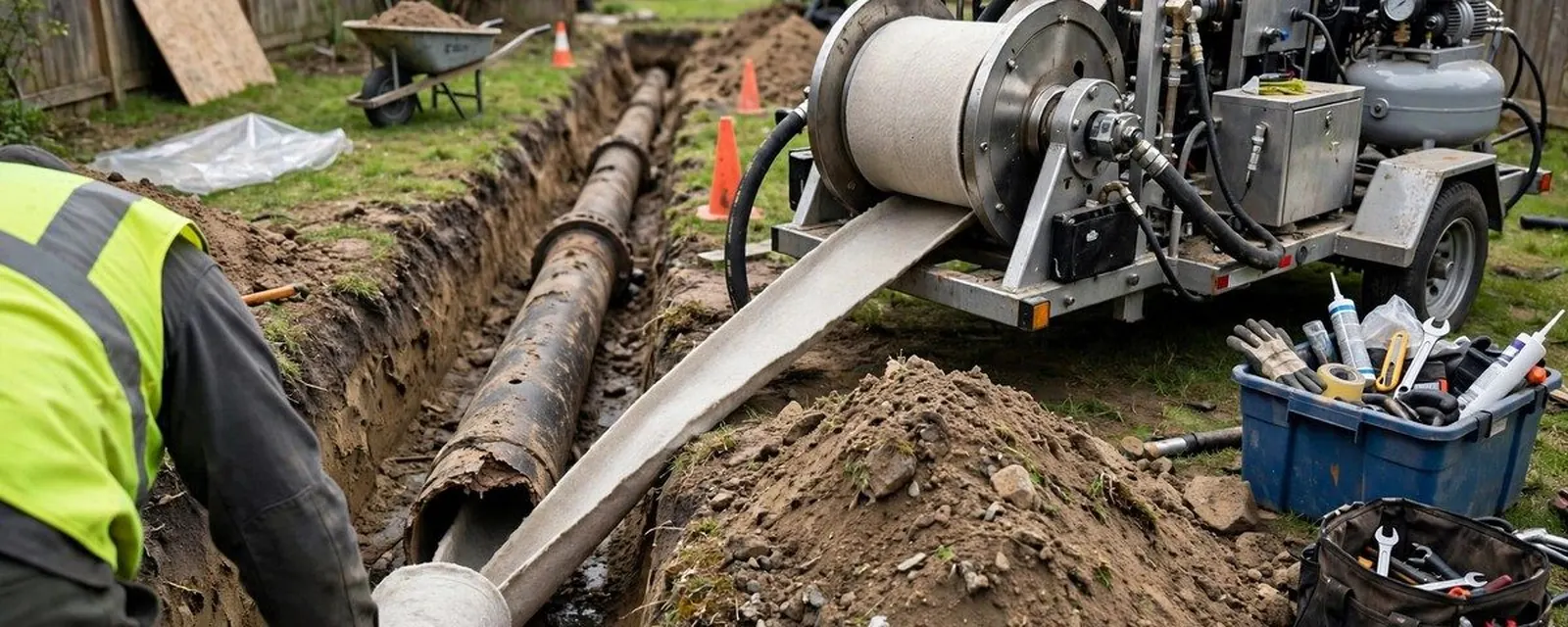
| Pipe bursting | A cone pulls new pipe through while breaking the old | Whole-run replacement without a full trench | Needs entry and exit pits, and can be risky near other utilities |
| Full trench replacement | Dig the entire run and lay new pipe at correct grade | Collapsed, bellied or crushed pipe | Most disruption and restoration, but fixes grade and everything else |
Lining is not a patch for a pipe that holds water in a low spot. A bellied line still collects waste after a liner goes in.
Rules for the district main and your private line
JBID owns the sewer main in the street. You own the line from the house to that main. The district says it is against the law for it to work on private property, and a lateral failure is the owner's expense unless the district knew of a main problem and did not fix it.
Replacement work follows JBID's lateral installation rules. These rules call for the International Plumbing Code. They also set a minimum 2 percent grade on a 4 inch lateral and 4 feet of cover over sewer pipe. A cleanout belongs within 5 feet of the building and again every 100 feet. The district inspects before backfill with 24 hours notice at 801-571-1166.
The rules also say no groundwater is permitted in the sewer line or its trench. In practice, that means we dewater the trench and keep it separate from the line. Call 811 before any digging, since Blue Stakes does not mark private laterals and the green sewer flag will not show yours.
Not sure whether it is a clog or a broken pipe? Call (385) 488-1892 and we will send a plumber with a camera.
Call (385) 488-1892What we check before recommending a repair
A repair plan is only as good as the survey behind it. The list below is what we confirm before quoting.
- Pipe material, whether clay, cast iron, PVC, ABS or a bitumen fiber product, since each fails in its own way
- Grade along the run, to spot a belly that will hold waste regardless of repair method
- Number and position of defects, which decides spot repair versus whole-run work
- Depth and surface above the pipe, such as concrete, trees, or neighbor property lines
- Location of the cleanout and whether another should be added at the same time
We give you the camera recording and the locate marks so another contractor can see what we saw.
Soils, roots and what shifts a pipe in Herriman
The Utah Geological Survey documents collapsible and expansive soils in the Copperton quadrangle, which includes north and northwest Herriman. Those soils settle when wetted or swell and shrink with moisture, and the survey notes they can damage underground utilities. That covers only part of the city, so it is a reason to camera your line, not a blanket claim.
Roots are the other major cause. A lateral laid in the late 1990s and 2000s through Anthem, Rosecrest or the older parts of Herriman may now run beneath mature landscaping. Roots enter at joint gaps and thicken, and that is the failure we see lined most often.
Septic, main sewer cleaning and where this page stops
Three nearby topics often come up on the same call.
Septic systems
Herriman is sewered by JBID, so septic tanks are uncommon. If your property has one, tell dispatch, because it changes the repair path and we do not service drain fields.
Main line cleaning
If a camera shows no damage, the fix is cleaning rather than repair. The sewer line cleaning page covers that route.
Inspection only
Buying or selling and want the lateral recorded? JBID recommends inspecting a lateral at sale. See sewer inspection.
What sewer line repair costs and why quotes differ
You get a clear price before work starts, based on what the camera and locate show. These factors drive it.
- Length of the failureA single 4 foot break is a small job. A failed 80 foot lateral is a different project.
- Depth and surfacePipe 6 feet deep under concrete costs more to reach than pipe 3 feet under turf.
- Method chosenLining avoids digging but needs specialized equipment. Trench replacement costs more labor and restoration.
- Permits and inspectionAdding plumbing lines needs a city permit, while repair of existing lines does not. Permit rules vary, so ask the Herriman building department. JBID inspection applies to new lateral installation.
- RestorationSod, sprinkler heads and driveway cuts are separate from the pipe work and can change the total.
Sewer line failures from age, roots or settling are normally excluded from standard homeowner policies. Sudden backup damage inside the house may be covered if you have a sewer backup endorsement. JBID advises owners to check this. Ask your insurer before work begins.
Want your real number? Call (385) 488-1892 for a camera visit and a written plan with options.
When a repair is not the answer
Sometimes a backup is a clog, not a break. A camera that shows clean, sound pipe means you need cleaning, and we will say so instead of selling a repair. The hydro jetting page explains what a jet can and cannot do for a root-prone line.
We also do not take on work in the district's main. If the camera shows damage past your property line, we point you to JBID and document what we found.
Sewer repair questions Herriman homeowners ask
Do you handle sewer line repair emergencies at night or on weekends in Herriman?
Yes, dispatch takes sewer calls around the clock. At night the focus is usually stopping the backup and protecting the house, while a full repair is planned afterward. We do not promise arrival times. Call (385) 488-1892 and tell us which drains are affected.
How do I know if my sewer line needs repair or just cleaning?
A camera answers it. If the pipe is clean and straight after a cleaning, the clog was the problem. If it shows cracks, roots at joints, standing water in a belly, or a collapse, the pipe needs repair. Repeat backups in the same weeks are a hint.
Who pays for a broken sewer lateral?
The owner. JBID says the private line from the house to the district main is the owner's responsibility, and the district cannot work on private property. The exception it states is a main-line problem the district knew about and failed to fix.
Is trenchless sewer repair always cheaper?
Not always. Lining avoids digging but needs a cleaned, aligned pipe and special equipment. If the line has a belly or has collapsed, you pay for lining and still have the problem. Trench replacement can end up the better value.
How long does a sewer line repair take?
Spot repairs often take a day. Lining may take most of a day plus curing time. A full trench replacement can run two or three days depending on length and restoration. Your plumber will give a realistic window after the camera visit.
Do I need a permit for sewer line work?
Repair of existing plumbing typically does not need a city permit, while adding new plumbing lines does. Replacing a lateral may involve JBID inspection before backfill. Permit rules vary, so ask the Herriman building department and JBID before work.
Will you replace the lawn or driveway afterward?
We backfill and compact the trench. Sod, sprinkler repair and concrete replacement are separate trades, and we will tell you before the dig what restoration is yours to arrange.
Can I just keep cleaning the line instead of repairing it?
For a short time, sometimes. Each cleaning buys weeks or months. A cracked or rooted pipe keeps degrading, and an eventual collapse during a backup costs more than a planned repair. The drain cleaning page covers shorter-term fixes.
Backup or sunken lawn over the line? Call (385) 488-1892 for a camera visit and written options.
Call (385) 488-1892Sources and standards
The standards and local rules behind this service page are listed below. Rules and fees change, so read the current version before you rely on them.
- Jordan Basin Improvement District: collection system overview and lateral ownership
- Jordan Basin Improvement District: lateral installation instructions
- Blue Stakes of Utah 811: how it works
- Utah Geological Survey: Geologic Hazards of the Copperton Quadrangle (SS-152)
- 2024 International Plumbing Code (IPC), adopted statewide under Utah Code 15A-2-103