
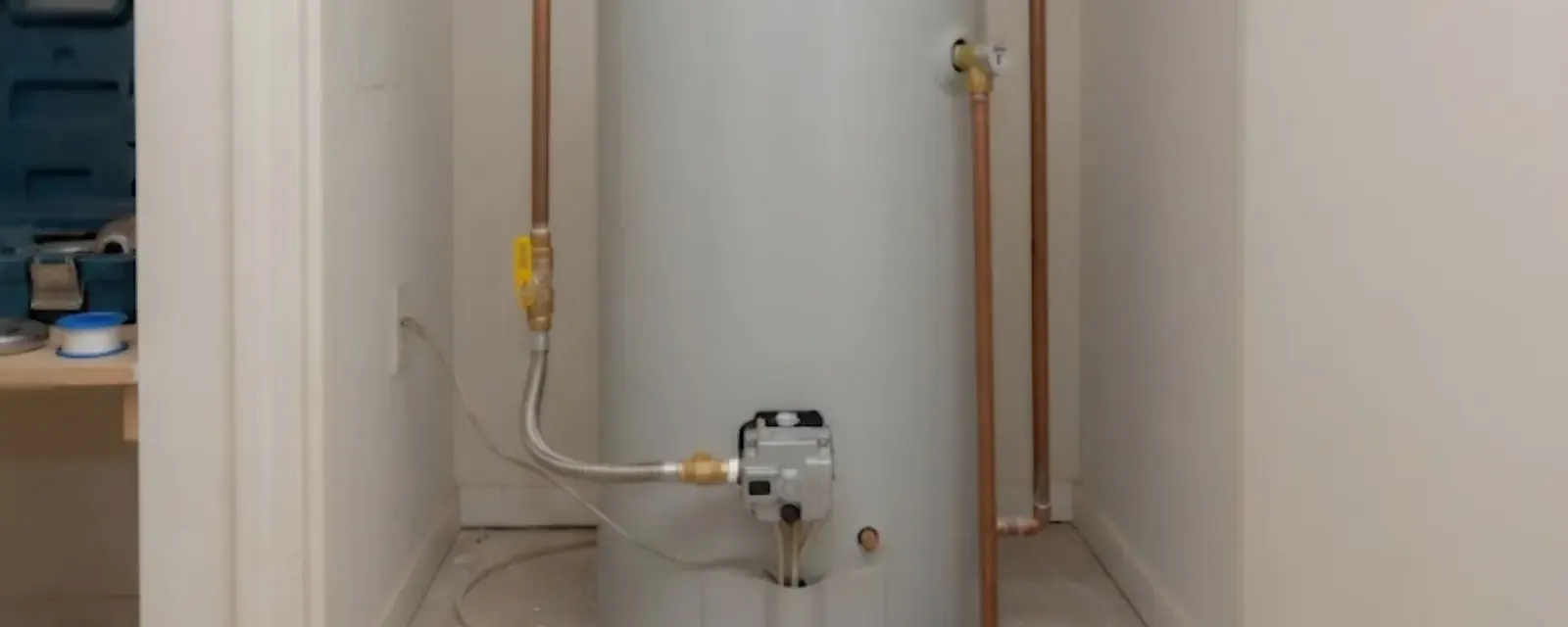
Water on the floor right now? Do these four things first
A failing tank can put dozens of gallons on the floor in an hour, so we treat it as urgent. Our 24/7 dispatch line is open, and while you wait you can limit the damage in about five minutes.
Work from the dry side of the room. Never reach for a breaker panel while standing in water.
Close the cold supply to the tank
Find the valve on the pipe feeding the top of the heater. Turn the lever crosswise to the pipe, or turn a round handle clockwise until it stops. If it will not budge, close the home's main water valve instead.
Cut the fuel
On a gas unit, turn the control dial to OFF and the gas valve handle crosswise to the pipe. On an electric unit, switch off the double-pole breaker for the heater. A dry tank with live elements burns them out in minutes.
Keep clear of wet wiring
Stay out of standing water near outlets, the heater's wiring box and the panel. If water has reached an outlet, leave the room and tell us when you call.
Move what water can ruin
Lift boxes, rugs and cardboard off the floor. Open a drain or door if the water has somewhere safe to go. Take photos for your insurer before you mop.
If you smell rotten eggs near a gas heater, leave the house and call 911 and Enbridge Gas at 1-800-767-1689 from outside. Do not flip switches or use a phone indoors. Call us once the utility has cleared the home.
Where the water comes from decides the verdict
Not every puddle means a dead tank. We trace the water upward before quoting anything, because a fitting repair costs a fraction of a new heater.
- Drips at the top, around the inlet and outlet nipples or flex connectors. Usually a fitting. Often fixed in under an hour.
- A steady trickle from the discharge tube beside the temperature and pressure relief valve. That is the valve doing its job, often because of thermal expansion, not a dead shell.
- A slow weep at the drain valve on the lower front. The valve can be swapped, but only if the tank itself is still sound.
- Water seeping from under the jacket, a rust-streaked pan, or a puddle that returns after you dry it. The inner tank has rusted through and the heater is finished.
- Beads of water on a cold tank in a humid room. That is condensation. Dry it and check again in an hour.
A leak at the bottom of the shell cannot be patched. Epoxy, tape and sealant fail within days because the steel is rotted behind the wet spot.
Replace now, repair, or wait a week
| What you see | Likely cause | Our usual call | Why |
|---|---|---|---|
| Water under the tank, source unclear | Rusted inner tank | Replace today | A breached shell cannot be sealed and can flood in hours. |
| Drip at a flex connector or nipple | Worn fitting | Repair | Replace the connector and check the shutoff. The tank is unaffected. |
| Relief valve dripping, tank under 8 years old | Thermal expansion or high pressure | Repair, add expansion tank | A new heater would drip too without the same fix. |
| Rumbling and popping, tank over 10 years old | Heavy scale on the bottom | Replace if leaking, flush if not | Thick scale insulates the water from the burner and overheats the steel. |
| No hot water, tank dry outside | Element, thermostat or gas control | Repair first | Parts are inexpensive on a tank that is otherwise sound. |
| Tank 12 or more years old, any problem | End of service life | Replace | Repairs rarely buy more than a season on an old tank. |
Age alone is not a verdict. A tank with a clean interior and a healthy anode rod can outlast a neighbor's that scaled up early. We check, we do not guess.
Why Herriman tanks scale up early
The city lists its own wells at 25 to 60 grains per gallon and Jordan Valley Water Conservancy District supply at 10 to 12. Its own scale calls anything over 10 very hard. Mineral crust builds on the tank floor and covers the lower element or burner chamber.
The blend also shifts. The city moves to the JVWCD-only winter source around mid-October and brings wells back as demand climbs in spring. That means hardness at your tap changes through the year, so test it before you choose a treatment plan.
In practice, hard water shortens tank life, and a new heater paired with a water softener or a yearly flush lasts longer than one left to scale.
Tank leaking or hot water gone? Call now and we will help you decide between repair and replacement.
Call (385) 488-1892How a same-day swap runs
A standard tank-for-tank replacement is a half-day job when the new unit is on the truck and the venting is sound.
Size the new tank
We match the first-hour rating to your fixtures, not just the old label. A 40-gallon tank feeding a soaking tub and a second shower runs out fast.
Shut down and drain
We close the supply, kill the fuel and drain the old tank to a floor drain or outside. Scale clogs the drain valve often, so we clear it with a hose bib adapter.
Set and connect
New flex connectors, dielectric fittings where copper meets steel, and a pressure relief valve with a full-size discharge tube pointed to a safe spot.
Add the protection
A drain pan with a drain line where the heater sits above living space, plus an expansion tank on closed systems.
Gas units get extra checks
We fit a sediment trap, test every joint with leak solution, confirm the draft hood pulls properly and look at the vent path for rust or loose joints.
Fill, purge and fire
We open a hot tap to push air out, check for weeping, set the thermostat and walk you through the shutoffs.
Gas, electric or hybrid, and what swaps cleanly
Same-fuel swaps are the fastest. Changing fuel type adds work that is better planned than rushed at midnight.
Gas tank to gas tank
The simplest swap. We reuse the gas line if it is sound, replace the flex connector and check the vent and combustion air supply.
Electric tank to electric tank
Needs a 240-volt circuit sized for the new unit's wattage. Corroded wire nuts and cooked terminals at the old heater are common.
Tank to heat pump hybrid
Efficient, but it needs open air space, a condensate drain and a cool room tolerance. Plan it instead of choosing it in a flooded basement.
Tank to tankless
A bigger project that needs gas line sizing and a gas diagram for the city. See our tankless water heater page for the full picture.
Moving the heater
Relocating adds pipe, venting and possibly a new permit scope. It is rarely a same-day emergency job.
Temporary fix
If parts or the right size are unavailable, we can sometimes stabilize a leaking fitting and return for the swap within days.
Permit and inspection in Herriman
The city's building page says replacing or adding a water heater needs a permit, while repair and maintenance of existing plumbing does not. That is why a fitting repair can happen tonight but a full swap carries paperwork. Permit rules vary, so ask the Herriman building department about your specific scope.
When the work is finished, an inspection is requested from the city. Inspections run Monday through Friday during business hours, and the city asks for at least one business day of notice. Work done without a permit can double the permit cost and may give an insurer a reason to push back on a claim.
So an emergency swap on a Saturday night means hot water that night and an inspection on a weekday. Plan to keep the area accessible for the inspector.
What we will not do
We do not install used or refurbished tanks, and we do not patch a leaking tank shell. We will not skip the relief valve discharge tube, the expansion tank on a closed system or the permit to speed up a job.
If the heater needs a new 240-volt circuit and the panel has no room, that is electrician work, and we will tell you so instead of improvising. If the venting is shared with a neighbor in a townhome, we may need your HOA or property manager before we change anything.
What drives the price of a replacement
We do not quote a flat number over the phone, because the tank itself is only part of the bill.
- Tank size and fuel type. A 50-gallon gas tank, a 40-gallon electric tank and a hybrid heat pump unit sit in very different price bands.
- Venting and gas work. A clean vent path costs nothing extra. Rusted flue pipe, wrong pitch or an undersized gas line adds parts and time.
- Code items. Expansion tank, drain pan, discharge tube, sediment trap and new shutoffs. Older installs often lack several of these.
- Access. A closet with a four-inch gap, an attic hatch or a crawlspace run takes longer than a garage wall.
- Timing and permit. After-hours calls, haul-away of the old tank and the permit itself are separate line items you will see before work begins.
A sudden tank rupture that floods a floor is often covered by homeowner insurance for the water damage, while the heater itself, as a worn-out appliance, usually is not. Slow leaks over months are commonly excluded. Ask your insurer before you mop.
Want your real number? Call (385) 488-1892 and describe the tank, the fuel and where it sits. You will hear a clear price before any work starts.
Questions about replacing a water heater
Do you handle water heater emergencies at night or on weekends in Herriman?
Yes. Our dispatch line takes water heater emergencies around the clock, including nights and weekends. Appointment times depend on the load that day, and we will give you an honest arrival estimate on the call. While you wait, close the cold supply valve and cut the fuel.
How long does a tank water heater usually last?
Most tanks run 8 to 12 years, and hard water pushes toward the short end. A yearly flush and a working anode rod stretch that. A tank older than 12 with any leak should be replaced instead of repaired.
Can the replacement be done the same day?
Often yes, for same-fuel swaps where the tank size is in stock. Fuel changes, relocations and tankless conversions need planning. We will say on the phone which category you are in.
Do I need a permit to replace a water heater in Herriman?
The city's building page says replacing a water heater requires a permit. Repairs to existing plumbing do not. Ask the Herriman building department if your project has unusual scope, such as moving the unit.
What size water heater do I need?
Sizing depends on the first-hour rating, not only the gallon capacity. Count how many people shower in the morning, whether you have a large tub, and whether a dishwasher or laundry runs at the same time.
A family of five with a soaking tub often needs more than the 40 gallons the last owner installed.
Should I switch to a tankless heater when this one fails?
Maybe. Tankless saves space and does not store water, but gas line sizing, venting and a gas diagram for the city are required. Our tankless page lays out when it makes sense and when it does not.
Will a water softener make my new heater last longer?
Softened water slows scale, which is the main early killer of tanks in very hard water areas. It is not a guarantee, and the softener needs its own maintenance. See softener options for sizing after you test your tap.
Not sure whether yours is repairable or finished? Call and describe where the water is coming from.
Call (385) 488-1892Sources and standards
The standards and local rules behind this service page are listed below. Rules and fees change, so read the current version before you rely on them.