
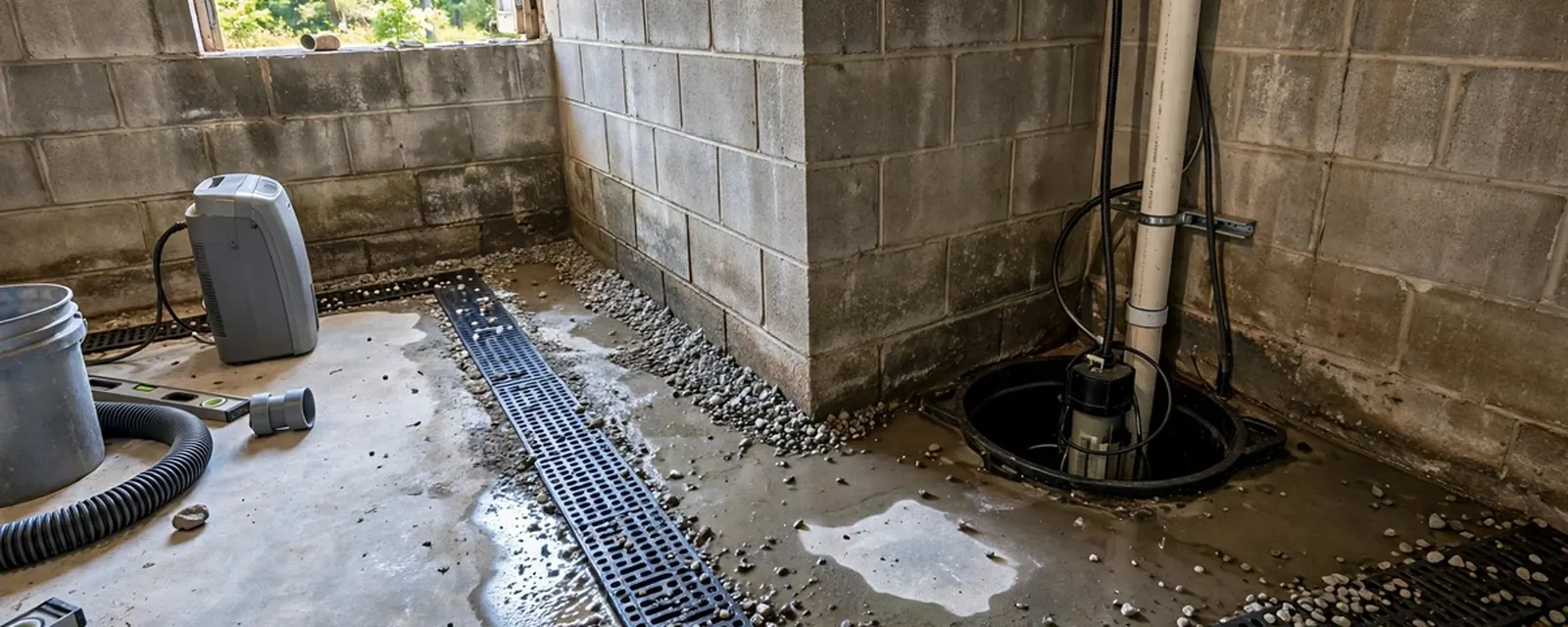
Where the water shows and who should act
Water in a new basement has a short list of sources. Match the symptom to the source first, because the fixes belong to different people.
| Where it shows | Likely source | First step | Who handles it |
|---|---|---|---|
| Seepage line where the wall meets the slab | Footing drain not carrying water, or high water table | Check the sump pit after a storm for water level | Plumber for pit and interior drain, builder for the exterior footing drain |
| Damp patch on a below-grade wall | Backfill settling and soil sloping toward the house | Measure the fall away from the wall | Owner or landscaper regrades, builder warranty may apply |
| Water collecting in a window well | Clogged well or a downspout dumping near it | Clear the gravel and extend the downspout | Owner, plumber if the well should tie into the footing drain |
| Stair-step crack with water | Foundation movement | Photograph and date it | Builder warranty or a structural engineer, not a plumber |
| Musty smell with no visible water | Humidity or radon pathways | Run a radon test and a dehumidifier | Owner |
Footing drains, window wells and downspouts
A footing drain is a perforated pipe, usually 4 inch, laid in washed gravel beside the footing and wrapped in filter fabric. It carries groundwater to a sump pit or out to daylight. When it works, the slab edge stays dry. When silt or a crushed section blocks it, water finds the wall joint.
Window wells are the usual weak point. A well should sit on a bed of gravel, drain downward and ideally connect to the footing drain, with a cover to keep rain out. Downspouts need extensions that land well beyond the well, since a roof sends hundreds of gallons into the soil in a single storm.
Sprinklers matter too. A head that soaks the foundation line wets backfill that is already settling. Move heads at least a few feet out from the wall and aim the spray away from window wells.
What Herriman requires and publishes about new construction
Herriman requires a state-licensed geotechnical engineer's soils report on all footing excavations, a rule in place since October 2006 because soil varies across the city. Ask your builder for the report on your lot. It describes the soil under the footing and is the first document to read if a basement seeps.
The city's grading page says ground must fall at least 6 inches within the first 10 feet away from the foundation, and hard surfaces within 10 feet must slope at least 2 percent away. Check with a 4 foot level and a tape. Pavers, a patio or a driveway that tilts toward the house can undo good waterproofing.
Each property must manage drainage on its own lot or convey it to a street or recorded easement. That means your downspout and yard runoff cannot be pushed onto a neighbor. It also means a neighbor's runoff is theirs to manage, which is worth knowing when a swale sits on a property line.
Herriman says most flooding comes from heavy rainstorms and microbursts, not snowmelt, and that standard homeowner insurance typically excludes external flood water. Ask your insurer about water backup coverage for a failed sump or sewer backup. The sandbags the city hands out are for yards and not a basement answer.
The Utah Geological Survey documents collapsible and expansive soils and shallow groundwater in the Copperton quadrangle, which covers only north Herriman. Collapsible soil settles when wetted, and irrigation is a trigger. If your lot is in that area, ask whether the soils report mentions it, and keep sprinklers off the foundation edge.
Large areas such as Olympia, a 933 acre area in northwest Herriman annexed in 2021, and the Rosecrest villages are still being built. Plenty of foundations here are in the years when backfill settles, so topping up soil near the wall with fill that slopes away is often the cheapest fix.
Seeing damp walls or a wet slab edge? Call (385) 488-1892 to talk through basement waterproofing and sump options in Herriman.
Call (385) 488-1892Sump pit basics for a new basement
Many new homes are built with a dry pit stub or a pit with no pump. A pit that stays dry is working as intended. If it begins to hold water after storms, installing a pump and check valve turns it into a real defense. See sump pump installation and repair for how the pit, pump and discharge fit together.
Use a sealed lid, because the state geological survey notes that radon enters through foundation openings and utility pipes. Test with a kit, since the state environmental agency says one in three Utah homes has high levels. Do not choose a discharge point without asking the building department where discharge is allowed.
Walk-through list for the first rainy season
Do this before your builder warranty window runs out, with dated photos.
- Walk the perimeter after a storm and look for pooling within 10 feet of the foundation.
- Confirm every downspout carries water at least several feet from the wall.
- Clear window wells, check the gravel and confirm the cover fits.
- Pour a bucket of water into the sump pit, if there is one, and watch for a drain connection.
- Mark any crack or damp patch with the date, a pencil mark and a photo, then send it to the builder in writing.
Honest limits
Waterproofing is not a single product. A plumber can install sump pits, pumps and interior drain lines, but cannot repair a poured footing, replace an exterior membrane or regrade a lot. Interior drains manage water instead of keeping it out. If seepage shows up in year one, document it and talk to the builder first. When the builder's work is done and water remains, basement waterproofing options for an existing basement come into play.
Nearby cities with the same questions
Water in new basements is a south valley issue, not a Herriman one. South Jordan tells owners near 1300 West and the Jordan River to check sump pumps because winter precipitation can raise groundwater, and tells everyone to point downspouts away from window wells.
Riverton asks for a Land Disturbance Permit with new construction permits for additions and walkouts. If you are adding a walkout, expect that step to affect drainage and plan the footing drain at the same time.
Questions homeowners ask
Does Herriman require a soils report for a new basement?
Yes. The city requires a state-licensed geotechnical engineer's soils report on all footing excavations, a rule dating to October 2006 because soil types differ across Herriman. Ask your builder for a copy, since it records what the engineer found under your footing.
Is dampproofing the same as waterproofing?
No. Dampproofing is a thin coating that resists soil moisture. Waterproofing is a membrane designed to resist water under pressure. Many builders apply dampproofing, which is why drainage and grading carry so much of the load.
Should I install a sump pump in a new build that feels dry?
A dry basement in the first season is not a promise for later years. If the pit stub is there, it is inexpensive to add a pump when water shows. Put it on your list after the first spring and the first big storm.
How soon after move-in will seepage show?
It often appears in the first one to three wet seasons while backfill settles, though some basements never see it. Watch after storms and keep dated photos.
Do window wells need a drain?
A drain helps, especially if the well bottom is below the footing. A well with no drain collects rain, and the water then has only the wall to find. Add a cover and a gravel base at minimum.
Can a dehumidifier fix a damp basement?
It removes moisture from the air, not water coming through a wall or slab. If humidity falls and wet spots return, the source is liquid water and needs drainage or grading work.
Water in a newer basement? Call (385) 488-1892 for a licensed plumber, or read about basement waterproofing.
Call (385) 488-1892Sources and standards
Local rules and figures in this guide come from the public sources below. Fees and codes change, so confirm the current version before you act on it.