
Run the shutoff test first
This takes ten minutes and tells you who to call.
Stop all water use
Turn off taps, the dishwasher, the washing machine and the ice maker. Do not flush. Tell everyone in the house.
Watch the lowest drain
Check the basement floor drain, the lowest tub or the lowest toilet. Water usually surfaces at the lowest opening first.
Wait 20 to 30 minutes
If the level falls or holds still, the backup was caused by water you were adding, which points to the house line or the lateral.
Note the result
If the level keeps rising with everything off, the flow is coming from the main. Move to the call list below.
Who owns what, who pays
| Where the blockage is | Owner | Who to call |
|---|---|---|
| Inside the house, past a fixture | Homeowner | Licensed plumber |
| Private lateral, house to the district main | Homeowner | Licensed plumber, camera and cleaning |
| District main under the street | JBID | JBID office or after-hours line |
JBID says it is against the law for the District to work on private property. The owner pays to fix the private line, and the District is liable only if it knew of a main problem and did not fix it.
What JBID tells Herriman homeowners
Sewer in Herriman is run by Jordan Basin Improvement District, formerly South Valley Sewer District, and its main office number is 801-571-1166. After hours, call 801-243-8492, and call 911 if the situation is life threatening. The district says its mains are typically 8 inches or larger, cleaned about every 18 months and televised about every five years.
JBID also recommends inspecting the lateral when a home is sold, and notes that roots can damage it. The Utah Geological Survey has mapped collapsible and expansive soils in the Copperton quadrangle, which includes north Herriman, and warns they can damage underground utilities. If you live in that part of town, ask for a camera inspection after a backup, since a shifted joint is one possible cause.
Insurance is not automatic. JBID advises owners to check whether their homeowner policy covers sewer backups, because many standard policies do not. Find out before the next storm or backup, not after.
Finding and using the cleanout
A cleanout is a capped pipe, usually 4 inches across, that gives direct access to the lateral. JBID's lateral installation rules call for one within 5 feet of the building and another every 100 feet, so look along the foundation wall nearest the street, in a utility room, or in a landscape bed near the house corner.
Do not remove the cap while the line is full. Standing sewage can release suddenly, so stand to the side, wear boots and gloves, and loosen it slowly. If water rises in the cleanout pipe, the blockage is downstream of it, which usually means the lateral or the main. If the cleanout stays dry while fixtures back up, the blockage is upstream in the house line.
Backup that will not stop? Call (385) 488-1892 and a licensed plumber will run a camera through the lateral and tell you where the problem sits. See our sewer cleaning service.
Call (385) 488-1892What to do while you wait
Keep water use at zero and keep children and pets out of the affected room. Switch off power to outlets in a wet basement only if you can reach the panel without stepping in water, and otherwise leave it to a licensed electrician. Move belongings above the line.
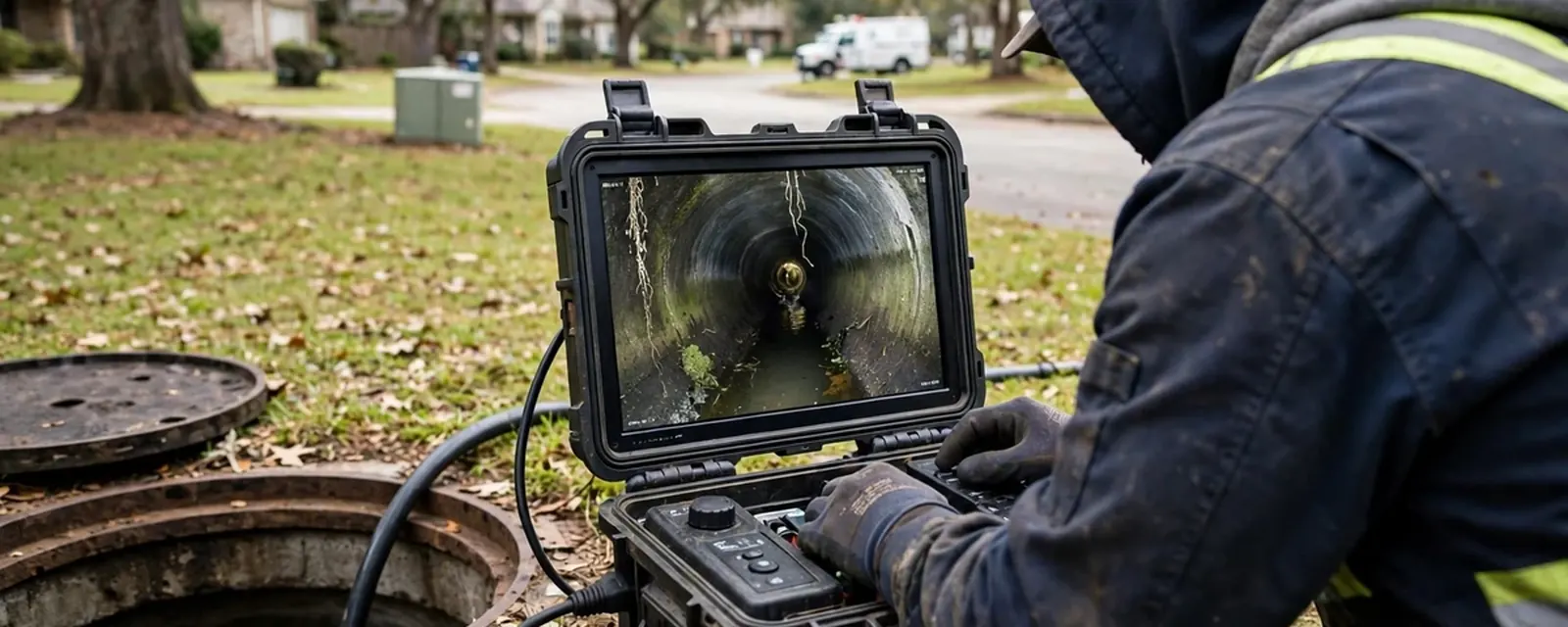
Take photos with a time stamp, which helps with any insurance claim. A plumber can run a drain machine or a camera through the lateral. See the details on sewer line cleaning and sewer camera inspection.
Common reasons laterals back up
Tree roots find the small gaps at clay or older pipe joints and fill the pipe with a fibrous mat. Grease settles on cool pipe walls and narrows the opening a little more with every dishwasher cycle. Wipes bunch together at a bend and snag everything behind them.
A sag in the line, sometimes called a belly, holds standing water and collects paper. Each of these has a different cure. Cutting roots needs a cable with a blade or hydro jetting, while a sag or a broken joint needs a repair. That is why a camera run comes before a repair decision.
After the water goes down
Sewage is not ordinary water. Wet drywall, carpet pad and insulation touched by it usually need to come out, and hard surfaces need disinfecting. Wear gloves, boots and a mask, and run fans to dry the space.
Ask the plumber to document what was found and where, and keep the camera video. If the cause was in the main, that record supports a conversation with the district. If it was your lateral, it shows what needs repair so the backup does not return.
Do not flush these
JBID says only human waste and toilet paper belong in a toilet. Baby wipes, wipes labeled flushable, feminine products, rags and cotton swabs all cause backups, and grease belongs in the trash.
Nearby cities, same district
JBID also serves homes in Riverton and Bluffdale, so the shutoff test and the ownership rules above apply there as well. The district headquarters is in Bluffdale.
Sewer backup questions from Herriman homes
Should I call JBID or a plumber first?
Run the shutoff test. If the backup stops when all water use stops, call a plumber. If it keeps rising with all taps off, call JBID and then a plumber.
Will my homeowner insurance pay for a sewer backup?
Not automatically. JBID advises checking your policy, and many standard policies exclude sewer backup unless an endorsement is added.
Is a floor drain backup always a main line problem?
No. The floor drain is simply the lowest opening, so it shows trouble from the house line, the lateral or the main.
Can I just open the cleanout myself?
You can, with care, but never while the line is full of backed-up sewage. Stand to the side and expect a sudden release.
Could ground movement in north Herriman damage a sewer lateral?
The Utah Geological Survey notes that collapsible and expansive soils in the Copperton quadrangle, which includes north Herriman, can damage underground utilities. A camera run shows whether a pipe has shifted or separated.
Water coming up from a drain right now? Call (385) 488-1892, dispatch runs around the clock.
Call (385) 488-1892Sources and standards
Local rules and figures in this guide come from the public sources below. Fees and codes change, so confirm the current version before you act on it.